What do you think about this?
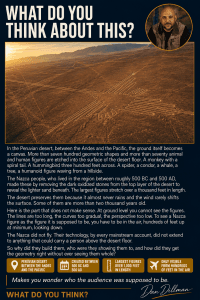
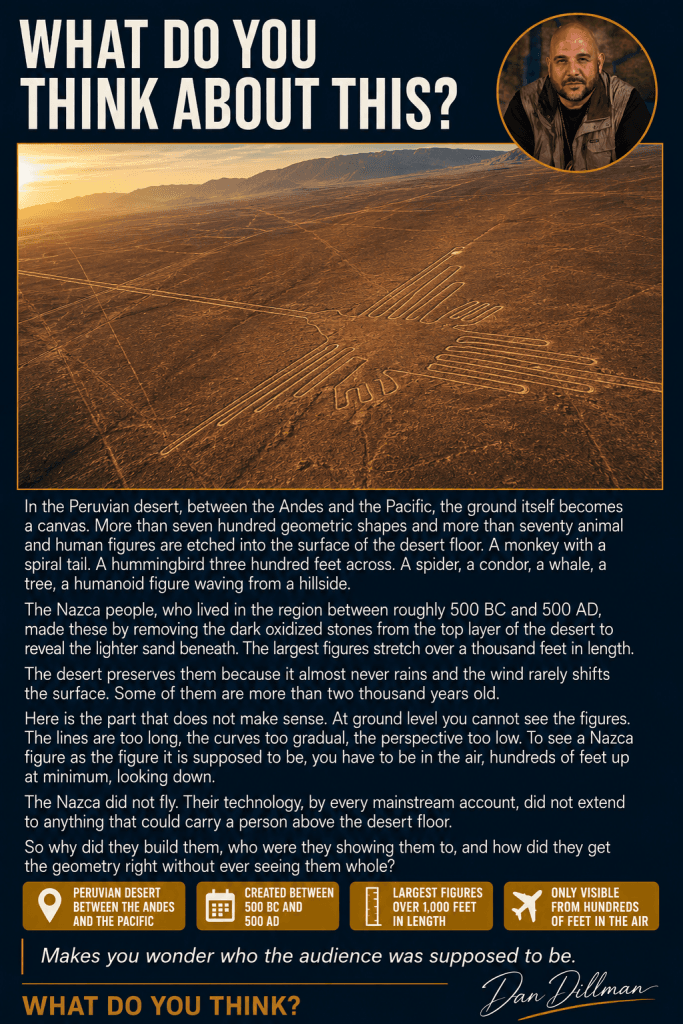
In the Peruvian desert, between the Andes and the Pacific, the ground itself becomes a canvas. More than seven hundred geometric shapes and more than seventy animal and human figures are etched into the surface of the desert floor. A monkey with a spiral tail. A hummingbird three hundred feet across. A spider, a condor, a whale, a tree, a humanoid figure waving from a hillside.
The Nazca people, who lived in the region between roughly 500 BC and 500 AD, made these by removing the dark oxidized stones from the top layer of the desert to reveal the lighter sand beneath. The largest figures stretch over a thousand feet in length.
The desert preserves them because it almost never rains and the wind rarely shifts the surface. Some of them are more than two thousand years old.
Here is the part that does not make sense. At ground level you cannot see the figures. The lines are too long, the curves too gradual, the perspective too low. To see a Nazca figure as the figure it is supposed to be, you have to be in the air, hundreds of feet up at minimum, looking down.
The Nazca did not fly. Their technology, by every mainstream account, did not extend to anything that could carry a person above the desert floor.
So why did they build them, who were they showing them to, and how did they get the geometry right without ever seeing them whole?
Makes you wonder who the audience was supposed to be.