What do you think about this?
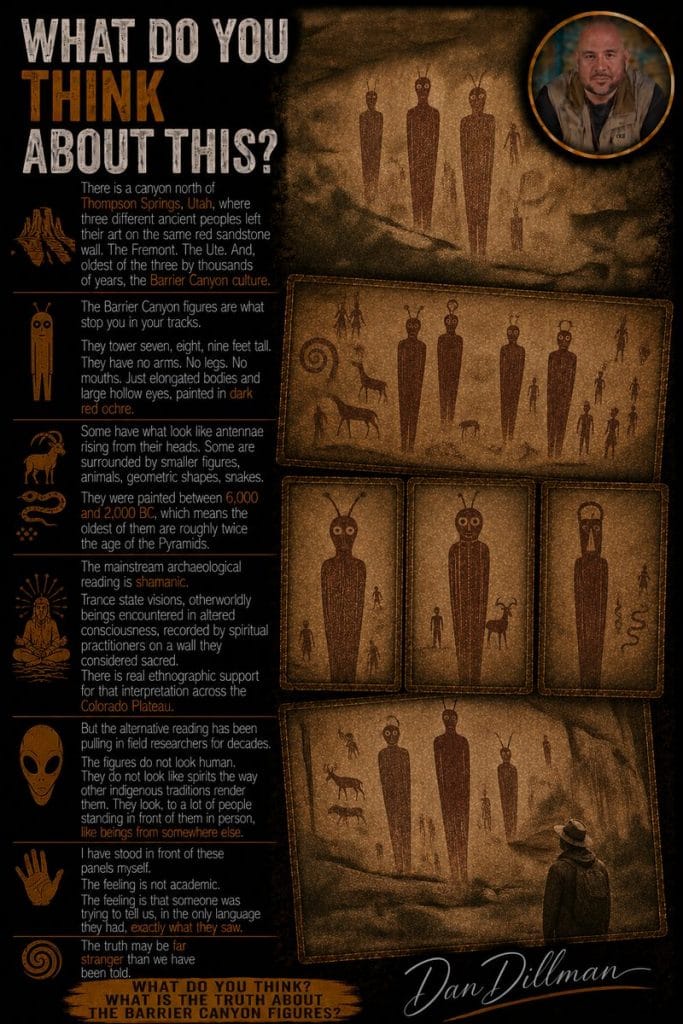
There is a canyon north of Thompson Springs, Utah, where three different ancient peoples left their art on the same red sandstone wall. The Fremont. The Ute. And, oldest of the three by thousands of years, the Barrier Canyon culture.
The Barrier Canyon figures are what stop you in your tracks.
They tower seven, eight, nine feet tall. They have no arms. No legs. No mouths. Just elongated bodies and large hollow eyes, painted in dark red ochre. Some have what look like antennae rising from their heads. Some are surrounded by smaller figures, animals, geometric shapes, snakes. They were painted between 6,000 and 2,000 BC, which means the oldest of them are roughly twice the age of the Pyramids.
The mainstream archaeological reading is shamanic. Trance state visions, otherworldly beings encountered in altered consciousness, recorded by spiritual practitioners on a wall they considered sacred. There is real ethnographic support for that interpretation across the Colorado Plateau.
But the alternative reading has been pulling in field researchers for decades. The figures do not look human. They do not look like spirits the way other indigenous traditions render them. They look, to a lot of people standing in front of them in person, like beings from somewhere else.
I have stood in front of these panels myself. The feeling is not academic. The feeling is that someone was trying to tell us, in the only language they had, exactly what they saw.
The truth may be far stranger than we have been told.