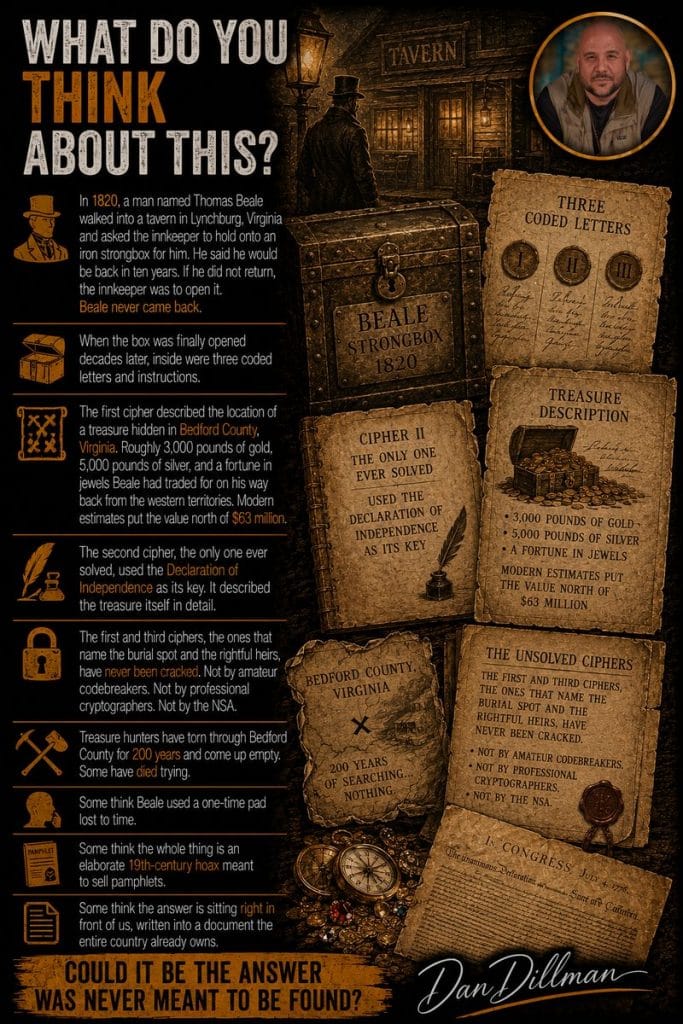
What do you think about this?
In 1820, a man named Thomas Beale walked into a tavern in Lynchburg, Virginia and asked the innkeeper to hold onto an iron strongbox for him. He said he would be back in ten years. If he did not return, the innkeeper was to open it.
Beale never came back.
When the box was finally opened decades later, inside were three coded letters and instructions. The first cipher described the location of a treasure hidden in Bedford County, Virginia. Roughly 3,000 pounds of gold, 5,000 pounds of silver, and a fortune in jewels Beale had traded for on his way back from the western territories. Modern estimates put the value north of $63 million.
The second cipher, the only one ever solved, used the Declaration of Independence as its key. It described the treasure itself in detail.
The first and third ciphers, the ones that name the burial spot and the rightful heirs, have never been cracked. Not by amateur codebreakers. Not by professional cryptographers. Not by the NSA.
Treasure hunters have torn through Bedford County for 200 years and come up empty. Some have died trying.
Some think Beale used a one-time pad lost to time. Some think the whole thing is an elaborate 19th-century hoax meant to sell pamphlets. Some think the answer is sitting right in front of us, written into a document the entire country already owns.
Could it be the answer was never meant to be found?