What do you think about this?
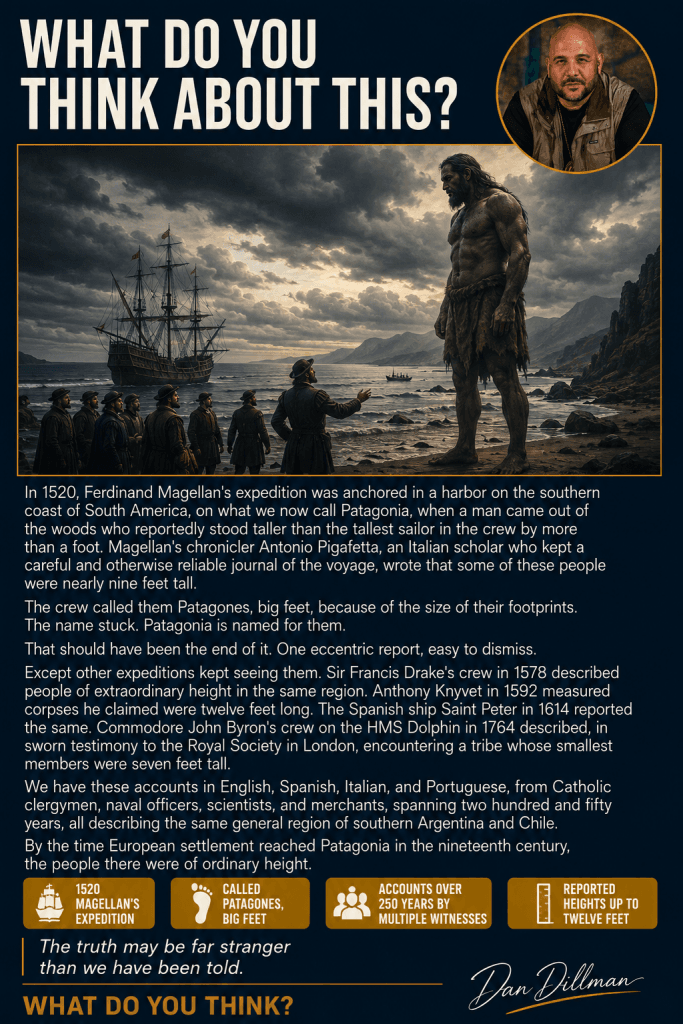
In 1520, Ferdinand Magellan’s expedition was anchored in a harbor on the southern coast of South America, on what we now call Patagonia, when a man came out of the woods who reportedly stood taller than the tallest sailor in the crew by more than a foot. Magellan’s chronicler Antonio Pigafetta, an Italian scholar who kept a careful and otherwise reliable journal of the voyage, wrote that some of these people were nearly nine feet tall.
The crew called them Patagones, big feet, because of the size of their footprints. The name stuck. Patagonia is named for them.
That should have been the end of it. One eccentric report, easy to dismiss.
Except other expeditions kept seeing them. Sir Francis Drake’s crew in 1578 described people of extraordinary height in the same region. Anthony Knyvet in 1592 measured corpses he claimed were twelve feet long. The Spanish ship Saint Peter in 1614 reported the same. Commodore John Byron’s crew on the HMS Dolphin in 1764 described, in sworn testimony to the Royal Society in London, encountering a tribe whose smallest members were seven feet tall.
We have these accounts in English, Spanish, Italian, and Portuguese, from Catholic clergymen, naval officers, scientists, and merchants, spanning two hundred and fifty years, all describing the same general region of southern Argentina and Chile.
By the time European settlement reached Patagonia in the nineteenth century, the people there were of ordinary height.
The truth may be far stranger than we have been told.