What do you think about this?
In 1936, a German archaeologist named Wilhelm Konig was working at a museum in Baghdad when he found something in the basement collection that did not belong to any catalogued period of Mesopotamian history.
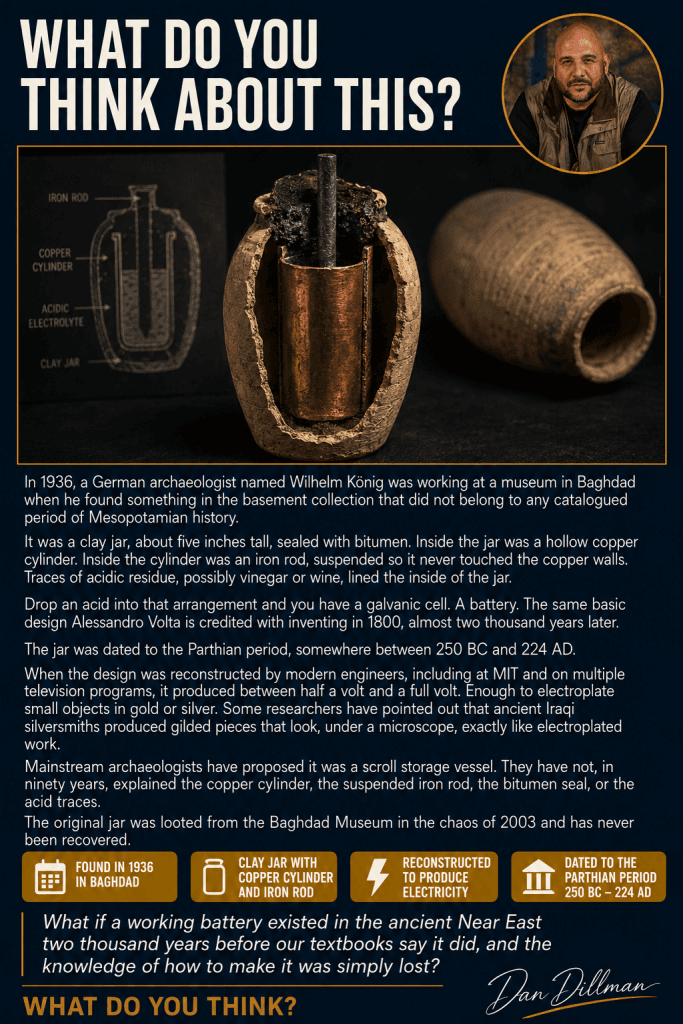
It was a clay jar, about five inches tall, sealed with bitumen. Inside the jar was a hollow copper cylinder. Inside the cylinder was an iron rod, suspended so it never touched the copper walls. Traces of acidic residue, possibly vinegar or wine, lined the inside of the jar.
Drop an acid into that arrangement and you have a galvanic cell. A battery. The same basic design Alessandro Volta is credited with inventing in 1800, almost two thousand years later.
The jar was dated to the Parthian period, somewhere between 250 BC and 224 AD.
When the design was reconstructed by modern engineers, including at MIT and on multiple television programs, it produced between half a volt and a full volt. Enough to electroplate small objects in gold or silver. Some researchers have pointed out that ancient Iraqi silversmiths produced gilded pieces that look, under a microscope, exactly like electroplated work.
Mainstream archaeologists have proposed it was a scroll storage vessel. They have not, in ninety years, explained the copper cylinder, the suspended iron rod, the bitumen seal, or the acid traces.
The original jar was looted from the Baghdad Museum in the chaos of 2003 and has never been recovered.
What if a working battery existed in the ancient Near East two thousand years before our textbooks say it did, and the knowledge of how to make it was simply lost?