The pyramid speaks in the voice of its own god.
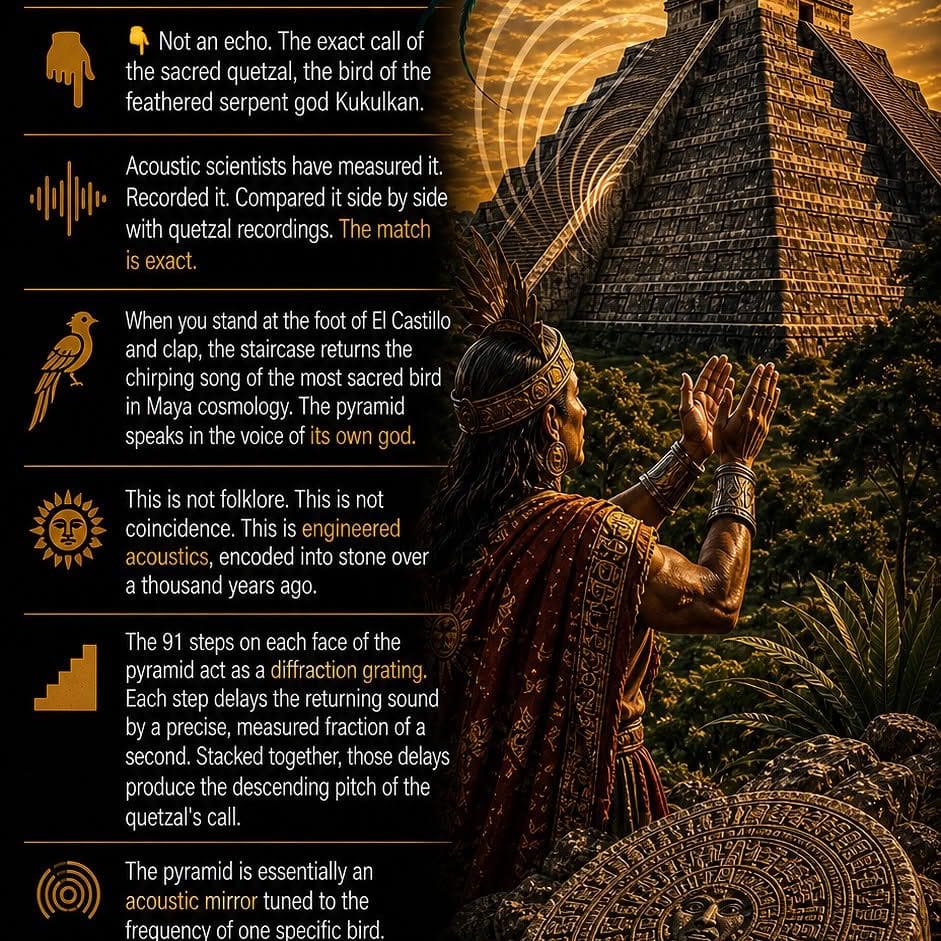
Stand at the base of the pyramid at Chichén Itzá and clap your hands. The pyramid claps back as a bird. Not an echo. The exact call of the sacred quetzal, the bird of the feathered serpent god Kukulkan.
Acoustic scientists have measured it. Recorded it. Compared it side by side with quetzal recordings. The match is exact. When you stand at the foot of El Castillo and clap, the staircase returns the chirping song of the most sacred bird in Maya cosmology. The pyramid speaks in the voice of its own god.
This is not folklore. This is not coincidence. This is engineered acoustics, encoded into stone over a thousand years ago.
The 91 steps on each face of the pyramid act as a diffraction grating. Each step delays the returning sound by a precise, measured fraction of a second. Stacked together, those delays produce the descending pitch of the quetzal’s call. The pyramid is essentially an acoustic mirror tuned to the frequency of one specific bird.
To engineer that, the priests had to understand frequency, pitch, sound reflection, distance-based time delay, and the precise audio signature of a living animal. They had to know all of it well enough to encode it in stone.
How did they know any of this?