What do you think about this?
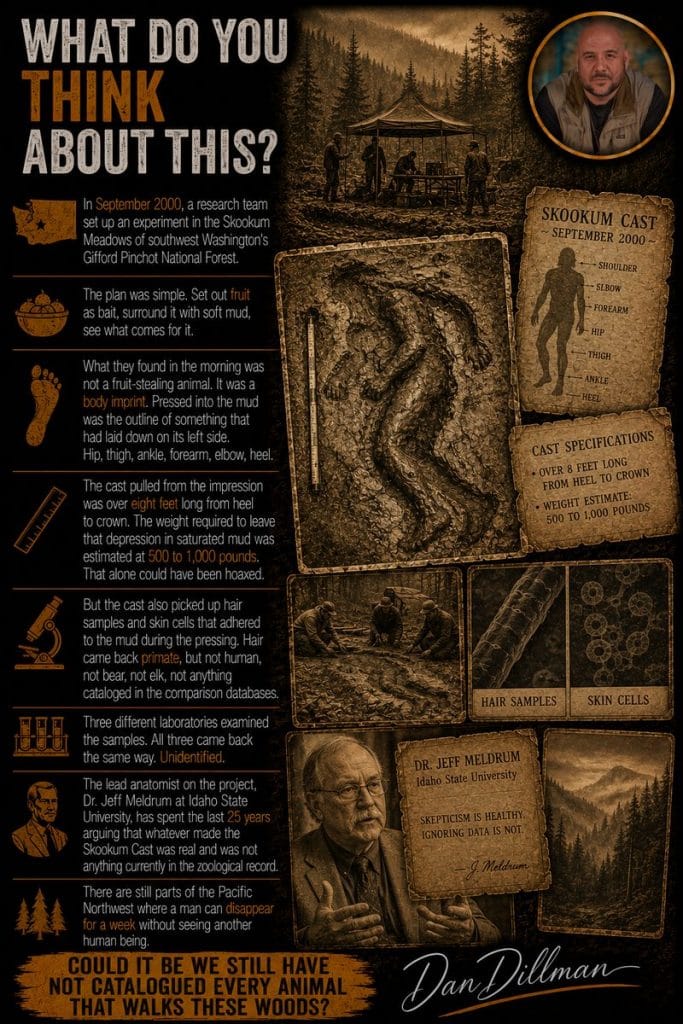
In September 2000, a research team set up an experiment in the Skookum Meadows of southwest Washington’s Gifford Pinchot National Forest. The plan was simple. Set out fruit as bait, surround it with soft mud, see what comes for it.
What they found in the morning was not a fruit-stealing animal. It was a body imprint.
Pressed into the mud was the outline of something that had laid down on its left side. Hip, thigh, ankle, forearm, elbow, heel. The cast pulled from the impression was over eight feet long from heel to crown. The weight required to leave that depression in saturated mud was estimated at 500 to 1,000 pounds.
That alone could have been hoaxed. But the cast also picked up hair samples and skin cells that adhered to the mud during the pressing. Hair came back primate, but not human, not bear, not elk, not anything cataloged in the comparison databases. Three different laboratories examined the samples. All three came back the same way. Unidentified.
The lead anatomist on the project, Dr. Jeff Meldrum at Idaho State University, has spent the last 25 years arguing that whatever made the Skookum Cast was real and was not anything currently in the zoological record.
There are still parts of the Pacific Northwest where a man can disappear for a week without seeing another human being.
Could it be we still have not catalogued every animal that walks these woods?