What do you think about this?
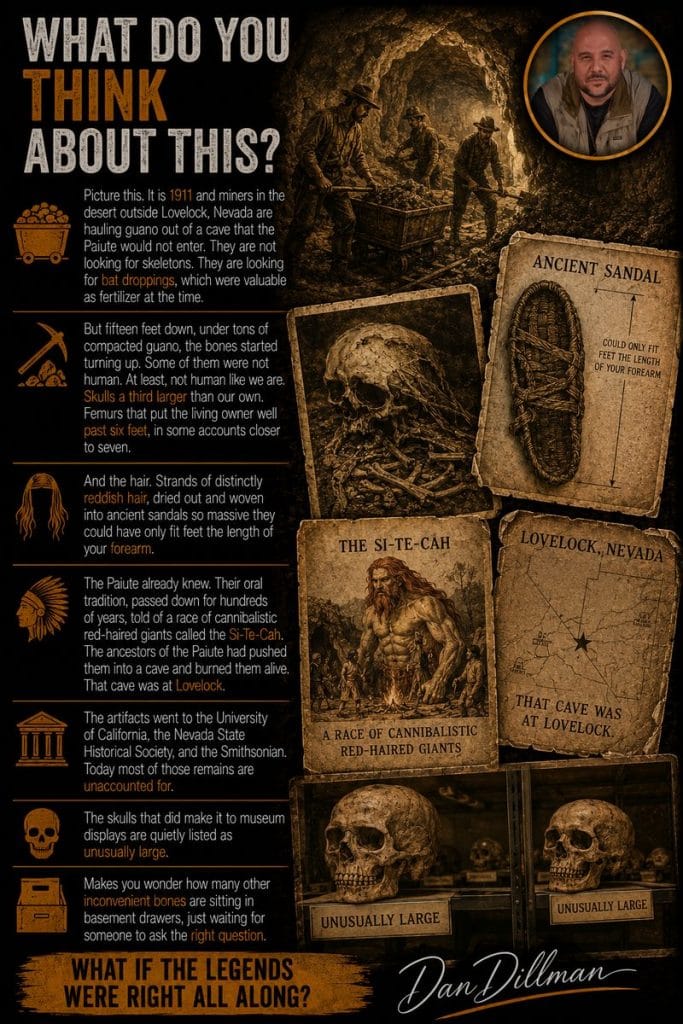
Picture this. It is 1911 and miners in the desert outside Lovelock, Nevada are hauling guano out of a cave that the Paiute would not enter.
They are not looking for skeletons. They are looking for bat droppings, which were valuable as fertilizer at the time. But fifteen feet down, under tons of compacted guano, the bones started turning up.
Some of them were not human. At least, not human like we are. Skulls a third larger than our own. Femurs that put the living owner well past six feet, in some accounts closer to seven. And the hair. Strands of distinctly reddish hair, dried out and woven into ancient sandals so massive they could have only fit feet the length of your forearm.
The Paiute already knew. Their oral tradition, passed down for hundreds of years, told of a race of cannibalistic red-haired giants called the Si-Te-Cah. The ancestors of the Paiute had pushed them into a cave and burned them alive. That cave was at Lovelock.
The artifacts went to the University of California, the Nevada State Historical Society, and the Smithsonian.
Today most of those remains are unaccounted for. The skulls that did make it to museum displays are quietly listed as “unusually large.”
Makes you wonder how many other inconvenient bones are sitting in basement drawers, just waiting for someone to ask the right question.
What if the legends were right all along?