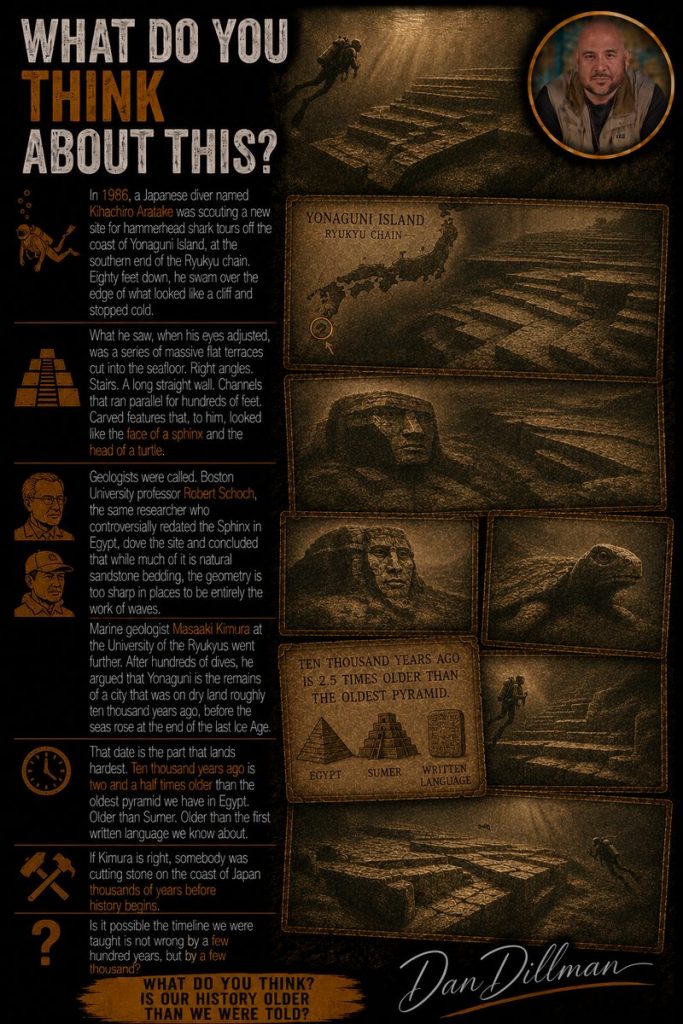
What do you think about this?
In 1986, a Japanese diver named Kihachiro Aratake was scouting a new site for hammerhead shark tours off the coast of Yonaguni Island, at the southern end of the Ryukyu chain. Eighty feet down, he swam over the edge of what looked like a cliff and stopped cold.
What he saw, when his eyes adjusted, was a series of massive flat terraces cut into the seafloor. Right angles. Stairs. A long straight wall. Channels that ran parallel for hundreds of feet. Carved features that, to him, looked like the face of a sphinx and the head of a turtle.
Geologists were called. Boston University professor Robert Schoch, the same researcher who controversially redated the Sphinx in Egypt, dove the site and concluded that while much of it is natural sandstone bedding, the geometry is too sharp in places to be entirely the work of waves. Marine geologist Masaaki Kimura at the University of the Ryukyus went further. After hundreds of dives, he argued that Yonaguni is the remains of a city that was on dry land roughly ten thousand years ago, before the seas rose at the end of the last Ice Age.
That date is the part that lands hardest. Ten thousand years ago is two and a half times older than the oldest pyramid we have in Egypt. Older than Sumer. Older than the first written language we know about.
If Kimura is right, somebody was cutting stone on the coast of Japan thousands of years before history begins.
Is it possible the timeline we were taught is not wrong by a few hundred years, but by a few thousand?